Inventor
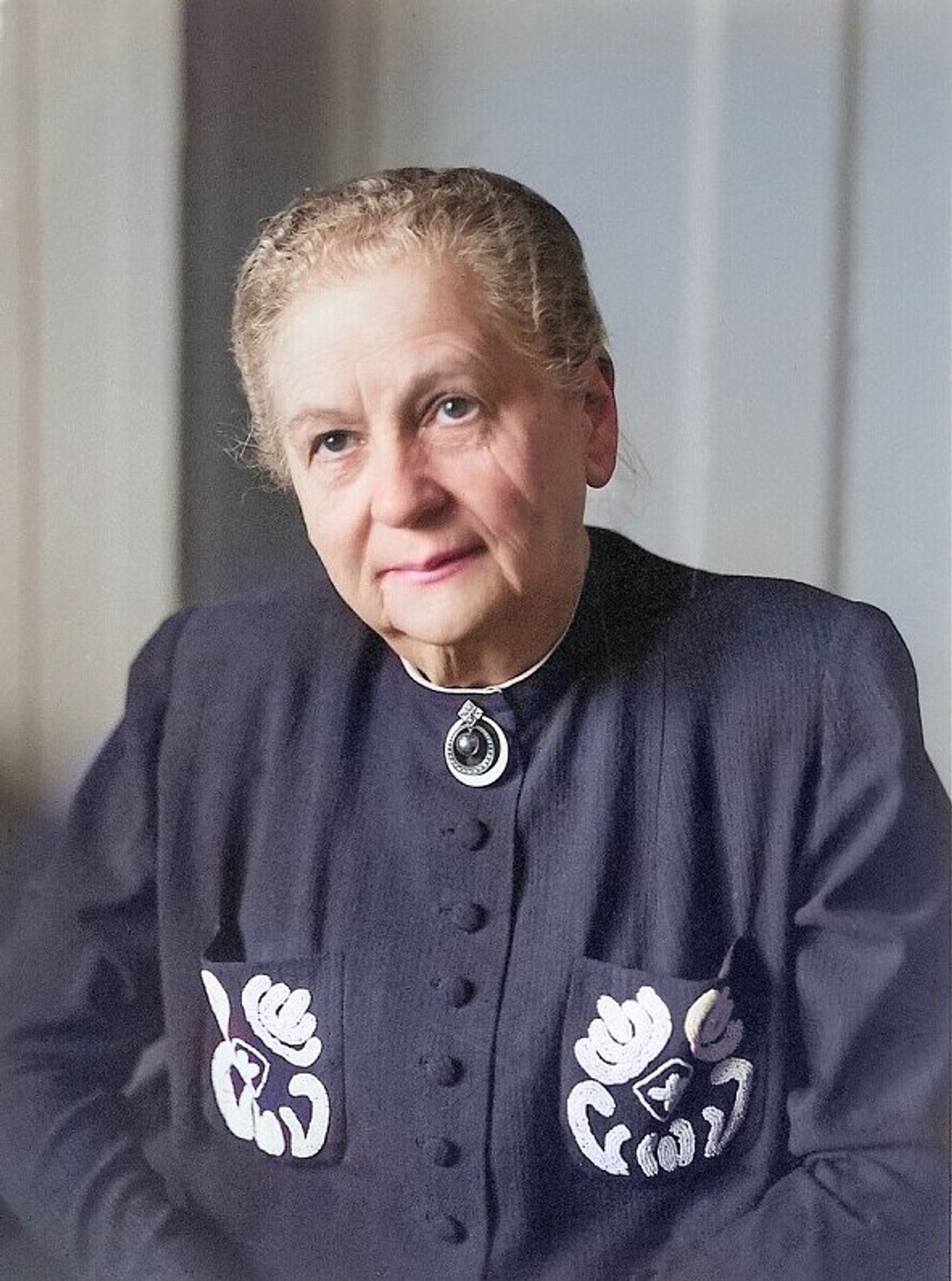
Melitta Bentz
Inventor of the paper coffee filter · 1873–1950
“She got tired of bad coffee and changed how the world drinks it”
The blotting paper belonged to one of her sons. Sometime in 1908, in a flat in Dresden, Melitta Bentz tore a sheet out of his exercise book, cut it to fit the bottom of a brass pot and poured hot water over ground coffee. The pot had been punched full of holes with a nail. What she had made was, in the company's own phrase, the world's first coffee filter with paper: hot, clear and free of grounds.
The grounds annoyed her. Coffee in a German household of the period was boiled or percolated until it turned bitter, or it was strained through a linen bag that had to be scrubbed clean after every use. Either way, some of the grounds, the Kaffeesatz, ended up in the cup. Bentz wanted to drink her coffee without chewing it.
Melitta Bentz (1873–1950) was a German entrepreneur from Dresden who invented the paper coffee filter in 1908 and founded the company that still carries her name. She was born Amalie Auguste Melitta Liebscher on 31 January 1873 and registered her filter with the Imperial Patent Office in Berlin on 20 June 1908, then entered her business in the Dresden commercial register that December. She died on 29 June 1950 at Holzhausen near Minden. Hers was not the first way to strain coffee. By the company's account it was the first to do it with a disposable sheet of paper.
"Inventor of the coffee filter" needs a qualifier, and the qualifier is most of the story.
Not the first filter
The Smithsonian holds an English drip coffee maker from about 1850 to 1875, with a removable perforated basket for the grounds. In 1865 James H. Nason of Massachusetts patented a coffee "filter or percolator" and wrote in the specification that various percolators or filters "of more or less practicability" were already in common use. Linen bags were in use too. So the answer to who invented the coffee filter depends on what you count as a filter. Bentz inherited a crowded field, and what she added was the sheet you throw away. The longer story of how coffee reached the cup is in our piece on the history of coffee.
Her own life before the filter is thinly recorded. She was a Dresden bookseller's daughter, and the New German Biography says she worked in the city as a saleswoman before she married. She married the merchant Hugo Bentz at the end of the 1890s, and by 1908 they had two sons, Willy and Horst. A daughter, Hertha, followed in 1911.
Brass, a nail and a school notebook
As the patent office reconstructs it, she began with a roughly perforated brass cup used as a sieve, then added a separate insert. By one telling she tried fabric as the insert first and found it wanting (Corner Coffee Store). Blotting paper did better. It held back the grounds, let the water through and went in the bin afterwards.
The logic seems to be this. A metal sieve fine enough to stop the grounds will clog, and one coarse enough to drain freely lets them through. Paper took over the fine work, so the brass could stay coarse and simply hold things up. Melitta holders have kept that arrangement ever since: a hard shell, a soft sheet.
The exercise book is in every telling, and it may be exactly right. No diary or application file survives to tell it in her own words. The patent office says her utility model papers were lost in the Second World War.
What was actually registered
The word "patent" gets used loosely here. What Berlin registered on 20 June 1908 was a utility model, a lighter form of protection than a full patent. The New German Biography gives the application date as 11 June, the number as 343556 and the entry in the Patent Gazette as 8 July. The title is a mouthful: a coffee filter with a base curved and recessed on the underside and with inclined flow holes. It protected a particular construction, not the idea of paper-filtered coffee.
A business with her name on it
On 15 December 1908 the business was entered in the Dresden commercial register as M. Bentz. Her name, not Hugo's. It began in a room of the family flat, with a registered capital of 72 pfennigs. The first fifty filter bodies came from a metal goods factory in Westphalia and the paper from a mill in Saxony. Hugo walked into shops and demonstrated the filter in their windows, Bentz demonstrated it at private coffee parties, which is where coffee actually gets drunk, and their sons delivered the first orders by handcart. Later the family hired women to stand in the shop windows instead, "demonstration ladies" in the patent office's phrase.
A filter is an easy thing to doubt until someone pours you a clear cup through it. It was a sales method built on that one minute. At the 1909 Leipzig Trade Fair the family sold more than 1,200 filters. In 1910 the filter won medals at the International Hygiene Exhibition in Dresden, and in September 1911 the firm registered Melitta as a word mark for coffee filters.
What the paper changed
The cleverness was in what it removed. A linen filter was a chore that came back every morning. A paper one took the washing out of coffee: the grounds and the paper went into the bin together and the next cup started clean. For a household that made coffee once or twice a day, that was a real subtraction of labour, mostly from the person who had been doing the scrubbing.
Paper is not only a sieve, either. A 2017 study in Food Research International found that the filter paper itself held back about 12 percent of the cafestol, an oil-associated compound, in the roasted coffee. Most of the rest stayed in the spent grounds, and only a tiny fraction reached the cup.
The first filters were round. The shape most of us now picture came later: the company patented a shaped filter bag and a ribbed porcelain holder with an oval, tapered base in the mid-1930s. In 1962 it began selling vacuum-packed ground coffee in Germany, and in 1965 it presented one of the first electric coffee machines. The kitchen prototype had become a system, and the system had become a habit.
Running it alone, then stepping back
The First World War nearly ended it. Coffee imports stopped, paper became scarce, and Hugo and one of the sons were sent to the front. The New German Biography says production turned to cartons and packaging, and the patent office says Bentz ran the company largely by herself through those years.
Afterwards it grew. In 1923 Willy joined and the firm became Bentz & Sohn. From then on, according to the biography, she was a silent partner. In 1929 the company left Dresden for Minden in Westphalia, where it is still based, and in 1932 it became Melitta-Werke AG, with 232 employees. She and Hugo divorced in 1931 and, ten years later, married each other again.
The company did not come through the Nazi years clean. By then her sons ran it. Horst joined the Nazi party and the SS in 1933, the firm was named a National Socialist "model enterprise," and during the war it used forced labourers. The patent office adds that production switched to pots and pans. After 1945 Horst was interned for two years. The record does not tie these decisions to Melitta, who had stepped back from running the firm. It also does not let the name off, because the name was hers.
She died on 29 June 1950 at Holzhausen near Minden and is buried in the Nordfriedhof there. No personal papers are known to survive, which is why so much of her story rests on the company and the patent office.
The name on the box
The company says it now makes around 50 million filters a day, and it is still in the Bentz family. Most objects we use every morning have no author we can name. This one has hers on the box.
There is a version of the story in which a housewife has a lucky idea at the kitchen table. The kitchen is the part everyone remembers because it needs no explanation. The rest is stranger and better: a saleswoman who took out protection in her own name, entered a firm in the trade register under her own name, and sold the product herself at coffee parties and in shop windows. Almost nobody reaching for a filter this morning will think of either version. That may be the most complete kind of success an invention can have. The name survived anyway, on a box in a cupboard in Yerevan or Seattle or Minden, and on a line in a Dresden register dated 15 December 1908 that reads M. Bentz.