Artist · Armenian
Srbuhi Dussap
Armenian novelist and women’s rights advocate · 1841–1901
She published Mayda in 1883 and became the first Armenian woman novelist. Years earlier she had already argued for women's education, women's work and a language everyone could read.
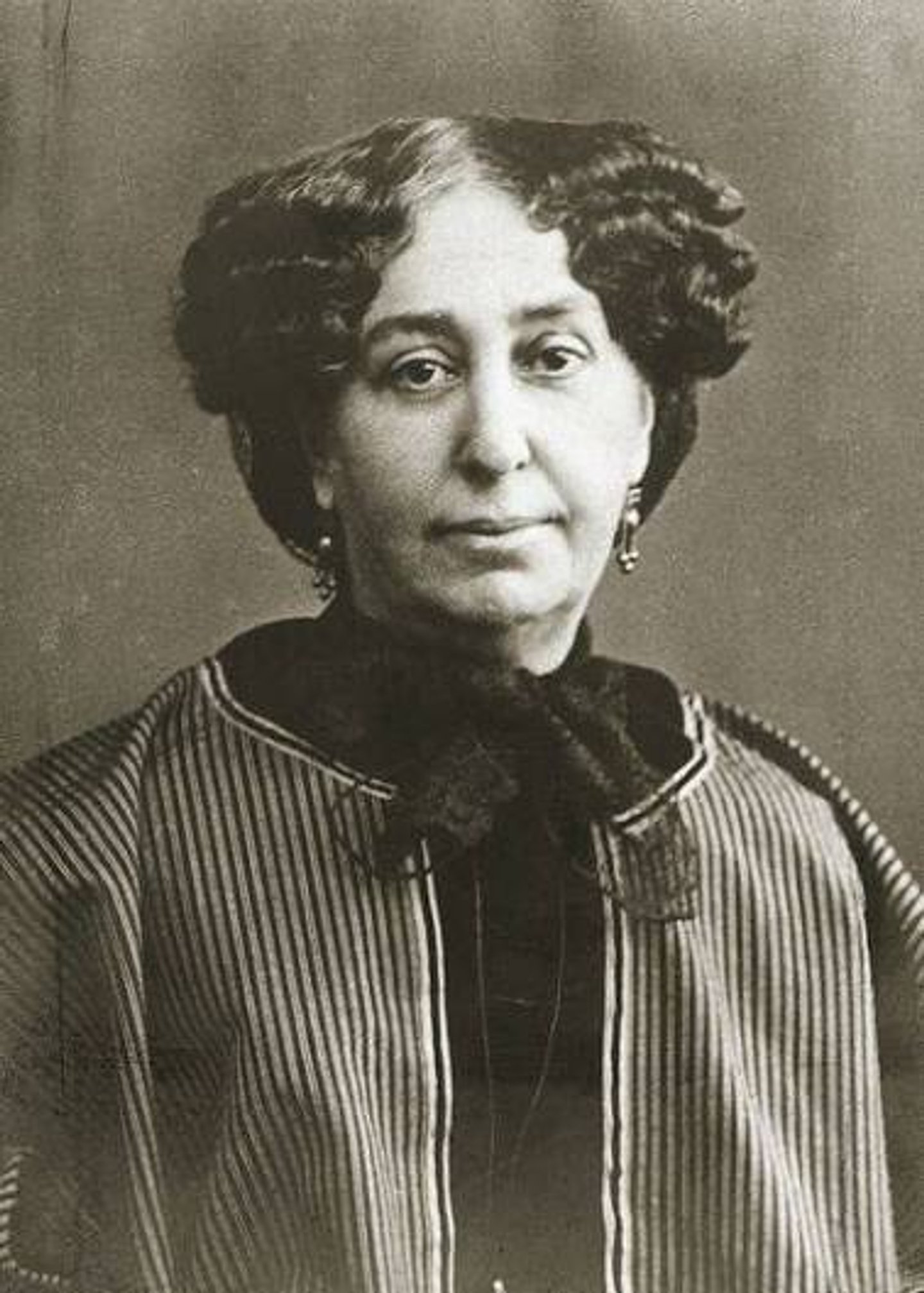
On a Sunday in late 1899, the writer Sibil went to call on Srbuhi Dussap in Constantinople, expecting to find her alone. Instead the anteroom was crowded with guests, most of them European. Dussap's husband received Sibil at the door and made the introductions. Dussap, in black and a black lace veil, spoke French to the room and Armenian to Sibil, and her tired face lit up the moment she began to talk. She was still in mourning for her daughter Dorine, who had died eight years before (Sibil's own account).
Sibil had been waiting for this for years. When Dussap's first novel, Mayda, appeared, she had written an article about it from Bilecik, a small town far from the capital. Later, working for a newspaper, she sketched Dussap's half-face behind her veil, and a friend came back with an invitation. She would title her account "Madame Dussap in Her Salon." Whether Dussap kept a regular salon is unclear, though some modern accounts describe her and her husband hosting French and Armenian intellectuals. What the scene shows is a woman who received people, in two languages, and knew what to do with a room.
Srbuhi Dussap (1841–1901) was an Ottoman-Armenian writer, born Srbuhi Vahanian in Ortaköy, Constantinople, and the first Armenian woman novelist. Sources differ on the birth year, giving 1840 or 1842 as well. Her Mayda appeared in 1883, followed by Siranush in 1884 and Araxia, or the Governess in 1887. Before any of them she had published a pamphlet on the Armenian language and a run of essays on women's education and work, and she spent the 1880s raising money to train women teachers. Dussap was her French husband's surname, not a pen name.
"First" is true. It is also the kind of fact that lets everyone stop reading.
A girl who had to choose Armenian
Her mother, Nazli Vahan, founded the Surp Hripsimyants girls' school in Ortaköy in 1859. Srbuhi was schooled in French until about ten, then taught at home in French, Greek and Italian, with her older brother as tutor. Armenian came later. The poet Mkrtich Beshiktashlian taught her the language, and by 1870 one of her poems stood on the first page of his collected works . She came to Armenian as a choice, not an inheritance, which may be why she argued about it so fiercely.
Around 1870 she married the French musician Paul Dussap. Sources give 1870 or 1871. Their daughter Dorine, born around then and known in Armenian as Arusyak, was baptised Catholic. A son, Edgar, appears in the record, and nothing more is documented about him.
The argument before the novels
Before she wrote a single novel, Dussap wrote a pamphlet. The Vernacular Armenian Language (1880) defended the vernacular as a literary language, a cultivated modern Armenian that ordinary readers could actually read. It was also a fundraiser. The title page says it was sold for the benefit of the Dprotsaser, the School-Loving Ladies' Society (Tebrotzassère in another transliteration, and the name its school still carries), and the dedication is addressed to the young women teaching poor Armenian girls.
Her case for a readable modern Armenian sits on top of an older story, told in our piece on the Armenian alphabet.
The Dprotsaser was founded on 1 May 1879 in Ortaköy by former pupils of the Hripsimyants school, with the aim of training teachers of Armenian for the provinces. Her mother, Nazli, was its first president. Srbuhi would succeed her. Her argument for the language and her work for girls' schooling were, quite literally, the same object.
The essays followed in quick order between 1880 and 1882: "Women's Education," "A Few Words on Women's Inactivity," "The Principle of Women's Work," "Armenian Societies." The one on inactivity argues that wealthy women's disdain for work harms their families and the poor, urges Armenian women to work rather than wait on benefactors, and insists that poverty is not shameful. Education means little without work to use it on, and idleness is not a feminine virtue.
In 1882 she gave a lecture in French to a Greek learned society in Constantinople. By the account we have, she felt she could not name Abovian, Nalbandian or Raffi, or even say the word "Armenia." A woman who had spent two years arguing for Armenian girls' schools stood in a room where the subject could not be named.
She was not a suffragist. There is no evidence that she campaigned for the vote, joined a party or signed petitions. Her feminism was practical and institutional: schools, paid work, the terms of marriage.
Three novels, one argument
The novels carry the same argument into fiction, each testing a different question.
Mayda (1883) is an epistolary novel, so private letters become public argument. Mayda, from a wealthy Constantinople family, is left penniless with a young daughter when her husband dies, and the society friends who once welcomed her stop acknowledging her. An older friend urges her toward independence. The question is whether a woman can have a self apart from the men who hold the money. Siranush (1884) turns to marriage and consent, and to what happens when family ambition outweighs a woman's feelings. Araxia, or the Governess (1887) follows a young woman trained in bookkeeping and mathematics who is shut out of the professions and ends up a governess. It is the fictional version of what the essays had been saying for years: an education is worth little if every door to work is closed.
Read in order, the novels look less like three books than one case tried under different conditions.
The fight over Mayda
Mayda sold out despite its high price, according to the critic Yeghia Demirdjibashian, who admired her range and marvelled that she still found time to receive visitors and work for women's schooling. Grigor Chilingirian was another supporter.
The objections came from several directions. Arpiar Arpiarian, writing in Bazmavep in 1903, called the books sermons and said they knew little of society. Hagop Baronian objected to the implausible plots. Matteos Mamurian supported the cause but questioned her realism. Krikor Zohrab, by one modern reviewer's account, took great offense at Mayda and condemned it. The Armenian literary establishment, in the Armenian Weekly's summary, largely turned against her novels.
The critics were arguing about two separate things at once: whether she was right about women, and whether the fiction was any good. Matteos Mamurian's verdict split the difference, backing the cause and doubting her realism, which is a polite way of saying the argument was allowed in the room as long as it did not have to be enjoyed.
It took until 2020 for Mayda to reach English readers, in Nareg Seferian's translation, the tenth title in the Armenian International Women's Association's series of Armenian women authors. It won the NAASR Sona Aronian Book Prize for 2021. A reviewer called it one of the best epistolary novels to date.
The women who came after
In the writer Sibil's account, Dussap wrote for women, spoke for women, and worked for them by leading the circles of women connected with the schools. She also cared for poor and abandoned women (Sibil). That is the strongest short proof that she was an activist and not only a writer. Sibil herself later wrote that as a young woman she had dreamed of becoming another Dussap (Wikipedia).
Zabel Yesayan went to see her too, as a young woman. According to EVN Report, Dussap warned her and Arshakouhi Teodik that literature held more blackthorns than laurels for women. When Yesayan said she wanted to be a writer, Dussap told her: "A male writer is free to be average, but never a female writer." A man could be forgiven a middling book. A woman would be asked to stand in for all of them.
The line of descent is easy to draw: Nazli to Dussap, Dussap to Sibil and Yesayan, and from there to the poets and organisers who took the argument further, such as Shushanik Kurghinian. Dussap did not found a movement. She was early enough that the women who followed could say they had read her.
Dorine, and what survives
Dorine died in 1891, at about twenty, reportedly of tuberculosis. Dussap withdrew from the press. In the house she kept a shrine to her daughter, and Sibil describes her praying for hours before the portrait. She is also said to have written a lullaby for Dorine.
We hear her voice from before the loss, too. Sibil prints a passage headed "From Madame Dussap's Diary," which she says she translated from a French manuscript. The entry is addressed to the baby Dorine at about twelve months old, and asks the child to keep the words in her heart. It is the one place where the author of the "sermons," as Arpiarian called them, is simply a mother writing to a child.
Much of Dussap's archive is said to have been lost, and the tale of its destruction is easy to repeat. It is also complicated. Sibil was reading an unpublished French manuscript of hers in 1899, years after Dorine's death, so at least some papers outlived the worst of it. Two letters and an address to the Mekhitarist scholar Fr Arsen Bagratuni were printed in Bazmavep in 1939 and 1940, though where the originals are now is unknown. Her French articles, the original diary manuscript and the novel manuscripts have never been located.
She died in Constantinople in January 1901. The society her mother started did better than her papers. In 1895 Sultan Abdulhamid II ordered its school closed; it reopened in 1909, followed the orphans west after the genocide, and settled in Le Raincy, outside Paris, where it opened on 16 September 1928 with 250 children. It is still there, still run by a board of volunteer women, as the École Tebrotzassère.
Being called "the first" is a way of being remembered without being read. The label fits on a plaque and survives a damaged archive. What it leaves out is the pamphlet sold to pay for a girls' school, the lecture with the missing word, and a woman who received her guests in two languages while still in mourning. Somewhere in the paper trail of nineteenth-century Constantinople there may be a French article of hers that nobody has opened. Until someone does, she is what her contemporaries made her: a woman people kept coming to see.