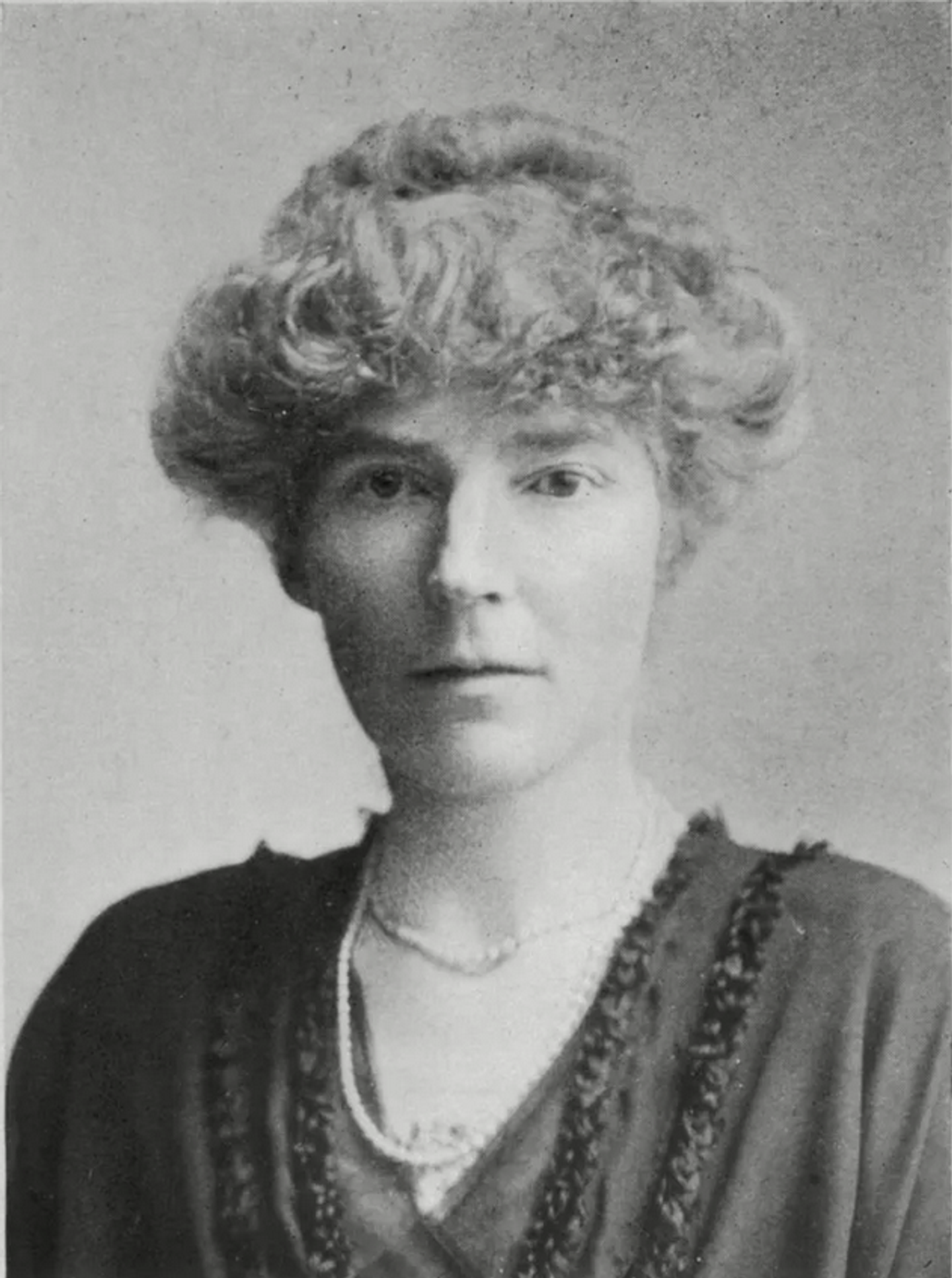
Activist
Gertrude Bell
Activist
"As for statecraft I really think you might search our history from end to end without finding poorer masters of it than Lloyd George and Winston Churchill. But why did we put them where they are? It's our fault."
Gertrude Bell wrote that to her father, off-handedly, the way you'd complain about the news over dinner. She had no idea, or maybe she did, that within the year she would be sitting at a conference table with one of the two men she'd just called a poor master of statecraft, helping him decide who would rule a country neither of them had ever lived in.
There is a photograph from that same year, 1921, taken in front of the Sphinx. Winston Churchill has just fallen off his camel. T. E. Lawrence is sitting stiffly in a civil servant's suit, looking like he would rather be anywhere else. And between them, in a rose-decked straw hat, riding like she was born to it, is Gertrude Bell.
Most people have heard of Lawrence of Arabia. He got a masterpiece of a film, an iconic performance by Peter O'Toole, and a permanent place in the Western imagination. Gertrude Bell got a Nicole Kidman movie with an 18% on Rotten Tomatoes.
That about sums up how history has treated the two of them.
And yet it was Bell who spoke the languages. Bell who had been held prisoner in the Arabian desert. Bell whose letters, sitting in an archive almost none of her profilers ever actually open, turn out to be funnier, sharper, and more heartbroken than anything a screenwriter has managed to invent for her.
Gertrude Margaret Lowthian Bell came into the world on 14 July 1868 at Washington New Hall, County Durham, the granddaughter of an ironmaster and Liberal MP, the daughter of a progressive industrialist who paid his workers sick leave before that was fashionable. Her mother died when Gertrude was three, giving birth to her brother Maurice, and that early loss cemented the defining relationship of her life: an intense, almost telepathic bond with her father, Hugh.
She was, by all accounts, a difficult child. Red-haired, blue-green-eyed, a handful for governesses. Her earliest surviving letter, written at five, thanks her grandmother for dolls. Her stepmother Florence, a playwright and welfare reformer, instilled duty, decorum, and a habit of hard work that would follow Gertrude everywhere, including to the middle of the Arabian desert.
Oxford, the Alps, and a Death in Tehran
At seventeen, she enrolled at Lady Margaret Hall, Oxford. Two years later, in 1888, she became the first woman to earn a first-class degree in Modern History from the university. Oxford wouldn't actually award degrees to women until 1920. The achievement came thirty-two years before the paper did.
Her reward was characteristically sideways. The family sent her to Bucharest and the London social season to, as one account puts it, get rid of her Oxfordy manner and find her a husband.
She found cigarettes instead.
In 1892, visiting her uncle Sir Frank Lascelles, the British Minister to Persia, she arrived in Tehran and fell in love with Henry Cadogan, a legation secretary with a talent for debt and a shared passion for the poetry of Hafiz. Her father refused consent. Cadogan was a gambler and not her social equal. He died within months, of pneumonia, though the myth of a romantic drowning or suicide has persisted in films ever since. Bell received the news by telegram, already back in England.
What she did next says everything about who she was. She threw herself into Alpine climbing. Between 1899 and 1904, she recorded roughly ten new routes in the Bernese Oberland. A peak in the Engelhörner, the 2,632-metre Gertrudspitze, was named after her. Her guide, Ulrich Führer, rated her as good as any man, which was, from a Swiss mountain guide in 1901, about as good as praise got.
Her most famous climb was a failure. In 1902, an attempt on the unclimbed northeast face of the Finsteraarhorn turned into a survival ordeal. A blizzard with hail and lightning trapped her party on the rock for roughly 53 hours. She came down with frostbitten hands and feet.
A few days later, from a hotel in Grindelwald, she wrote to her father about the weather, the other guests, and, almost as an afterthought, the small matter of having nearly died. She mentioned she'd sent him "an enormous volume" about the Engelhörner climbs, "from which you will see that I have not lived quite in vain."
That's the whole reflection she offers on 53 hours roped to a mountain in a blizzard. A joke, tucked between complaints about the rain.
And then she turned east.
Al-Khatun
Between 1905 and 1914, Gertrude Bell transformed herself into one of the most knowledgeable Westerners in the Middle East. She spoke Persian, Arabic, French, German, Italian, and Turkish. She found Arabic the hardest, noting there are at least three sounds almost impossible to the European throat. She published The Desert and the Sown in 1907, a travelogue of Syria, Anatolia, and Iraq that still reads well.
In 1907, surveying Byzantine churches in Anatolia, she met Charles "Dick" Doughty-Wylie, a British consul and the nephew of the Arabia Deserta writer Charles Doughty. He was married. Nothing happened for years. Then in August 1913 he visited the Bell family home, and something did happen, or almost did.
What survives of it is nearly a hundred letters, and they are not what you'd expect from the woman who ran the Arab Bureau. In January 1915, from a cramped Red Cross office in Boulogne, exhausted from twelve-hour days spent tracking down the missing and the dead, she wrote to him at two in the morning:
"Oh Dick, I'm afraid, I'm horribly afraid of you coming back to go into that fearful carnage... My dear, my dear, when shall I see you? Yet I don't want to see you lest it should be on the way to muddy trenches... Love me even when I grope along the lifeless sodden valley. For I am yours, Gertrude."
Partway through, she knocks over her inkwell onto her own bed. She keeps writing anyway. She complains about a colleague who rejected a hotel room for lacking electric light. She worries he'll forget her.
This is not the woman from the Cairo Conference photograph. It's the same woman, three years earlier, with the desk lamp on and no one watching.
He had called her, in a December 1913 letter, his queen of the desert. It is the exact phrase Werner Herzog borrowed for the title of his 2015 film about her, a detail almost none of the coverage of that film ever mentions. Everyone quoted the title. Almost nobody found where it came from.
Doughty-Wylie was killed by a sniper at Gallipoli on 26 April 1915, leading the capture of a hill armed only with a cane, out of respect for the Turkish troops who had once been his friends. He was posthumously awarded the Victoria Cross, the highest-ranking officer to receive one in that campaign. He is still buried where he fell, the only solitary war grave on the peninsula. A veiled woman laid a wreath there that November. The official record says it was his wife, Lilian. Some biographers have wondered if it was Bell.
There is no proof either way. Maybe that's the right ending for a love affair that was never allowed to have one.
Her archaeology was just as serious as her heartbreak, and just as prone to being scooped. In 1909 she surveyed Ukhaidir, an Abbasid desert palace, certain the find would make her name. She wrote to a German team about it, excited, generous with her discovery. The Germans published first. A Frenchman had already noted it in passing the year before that. By the time her own monograph appeared in 1914, she had been beaten twice over by people she had helped along the way.
The book held up regardless. She was the first to correctly date the palace, and the scholar she sparred with most over it, Ernst Herzfeld, ended up citing her nearly forty times. Being right eventually counts for more than being first.
She travelled roughly 1,800 miles from Damascus into territory controlled by the Rashidi dynasty, then ripping itself apart through assassination and civil war. She was the second Western woman to reach Ha'il. She was held under house arrest for eleven days. "In Hayil," she wrote in her diary, "murder is like the spilling of milk."
She carried evening gowns, cutlery, Wedgwood china, and table linen into the desert. She wore pearls and feathered hats in temperatures that would make most people reconsider existing. The reasoning was precise: a European wins more respect by keeping to their own customs. When Vita Sackville-West first met her in Constantinople, she described Bell as having come straight out of the desert with all the evening dresses, cutlery and napery she insisted on taking with her.
Iraqis called her al-Khatun, a Turkish and Persian-derived honorific meaning "the Lady," understood locally as a woman who keeps an eye and ear open for the good of the state. Some popular accounts give her the grander title Umm al-Muminin, "Mother of the Faithful." That's an Islamic honorific reserved for the wives of the Prophet Muhammad, and it isn't hers. Al-Khatun is the name that stuck. Al-Khatun is the name she earned.
Drawing Lines in the Sand
When the First World War broke out, everything Bell knew about the region's tribes, wells, and power dynamics became an intelligence asset. It was the same collapse of the Ottoman order that sent Armenian genocide survivors fleeing into neighborhoods like Bourj Hammoud, built from nothing a few years later. Bell was in the rooms deciding what would rise out of that same wreckage. She joined the Arab Bureau in Cairo in 1916, working alongside Lawrence, and was later sent to Basra, then Baghdad. She became Oriental Secretary to the British High Commissioner, the only woman in the entire British administration of the Middle East to hold formal political rank.
She fought with A. T. Wilson, the acting Civil Commissioner who wanted direct colonial rule. Bell wanted Arab self-government under British guidance, and she was clear-eyed, even at the time, about how badly the early administration had handled it. "We rushed into the business," she wrote to her stepmother in April 1916, "with our usual disregard for a comprehensive political scheme."
That was years before her 1920 white paper, Review of the Civil Administration of Mesopotamia, so well written that some members of Parliament were reportedly astonished it had been produced by a woman. That particular brand of surprise tends to follow women who are very good at their jobs.
At the 1921 Cairo Conference, she was the only woman at the table. The result was the Sharifian Solution: Faisal, son of Sharif Hussein, installed as King of Iraq. Bell championed this choice. She believed Faisal could hold together Sunni, Shia, and Kurdish factions under one crown.
Popular accounts sometimes credit her with single-handedly drawing Iraq's borders on tracing paper. It's a good story. It also overstates things. She was central to defining the southern desert frontiers and pushed for the inclusion of the three former Ottoman vilayets of Basra, Baghdad, and Mosul. Borders, like most consequential decisions, had more than one signature on them.
She was also, since 1908, the founding secretary of the Women's National Anti-Suffrage League. She did not believe all women should have the vote.
We'll come back to that.
The Museum and the Last Summer
In October 1922, Faisal made her Honorary Director of Antiquities. Not a ceremonial title. Bell wrote Iraq's first antiquities law herself, enacted in 1924, and built a Department of Antiquities that was, in practice, her and two other men. She founded what became the Iraq Museum out of two rooms in an old Ottoman building.
Her law set the rules for who got to keep what came out of the ground. Finds were split between the excavator and the country, and she was the one who decided which pieces stayed. At Ur, dividing a season's work with the archaeologist Leonard Woolley, she settled some of it by the toss of a coin. She kept a headless diorite statue of a Sumerian king in Baghdad. She kept the relief they called the milking scene.
Some Iraqi nationalists thought her law gave away too much to foreign excavators. After her death, it was rewritten to be far stricter. Whatever the argument, it was hers to have.
By 1926 the rest of her life was falling apart at the same speed the museum was coming together. The family steel business, battered by a postwar slump and the strikes building toward that year's General Strike, was no longer the fortune it had been. Her half-brother Hugo died of typhoid early that year. She had just come through pleurisy, on top of malaria and bronchitis, and had lost enough weight that people worried. The new High Commissioner did not lean on her the way Percy Cox once had. Faisal needed her less than he used to. Her dog died. So did the dog she was minding for a friend, two days apart.
None of it shows in her last surviving letter.
On 23 June 1926, nineteen days before she died, she wrote to her stepmother about cylinder seals. She was excited about matching some mace-head engravings to pieces already in her museum collection. A friend's new novel had gotten a bad review and she wanted to talk about it. Someone named Lionel had come in for tea.
It reads like any other Wednesday.
The first room of her museum, the Babylonian Stone Room, opened in June 1926, with Faisal himself there for it. She had one month left to live.
On the night of 11 July, she took an overdose of a sleeping drug called Dial. Her maid found her the next morning, two days before her fifty-eighth birthday. She had asked to be woken. She had also asked a friend to look after her dog if anything happened, and had written her stepmother, not long before, about how a lonely existence would not last forever.
The official record calls it accidental. Most people who have studied her closely do not believe that. No one can prove it either way, and probably no one ever will.
She was buried the same day in Baghdad, with full honors. Faisal watched from his balcony as the procession passed. Her will left the bulk of her money to the museum she had just finished building, worth remembering, since the story sometimes gets told as though she died with nothing at all.
What She Got Wrong
Here is where we have to sit with the whole of her, not just the parts that make a better story.
Bell was, by any measure, one of the most capable women of her century. She learned six languages by ear, mapped territory the British Empire didn't know existed, survived a blizzard nobody else would have walked away from, and helped decide the shape of a country that still exists today. She did all of it in a world built to make sure a woman never got the chance.
And in 1908, she became the founding secretary of the Women's National Anti-Suffrage League. She argued that women did not have the knowledge or education to be trusted with a vote.
Women who did not have her name, her wealth, her Oxford first. Women who faced every obstacle she had faced, and then several more she never had to think about.
It's tempting to smooth this over, to call it a product of its time and move on. We'd rather not do that. Bell knew exactly what it felt like to be underestimated because of her sex. She fought it her whole life, in Persia, in the Alps, in Whitehall, in Baghdad. And she still didn't extend that fight to women who weren't her.
That contradiction doesn't cancel out what she built. It just means the whole picture is more complicated than "trailblazer," and we think that's more interesting, not less. We get to tell her story today, contradictions included, because other women kept fighting the fight she opted out of. That's worth remembering too.
She was one of a kind. She wasn't always right. Both things are true, and neither one needs the other's permission.